
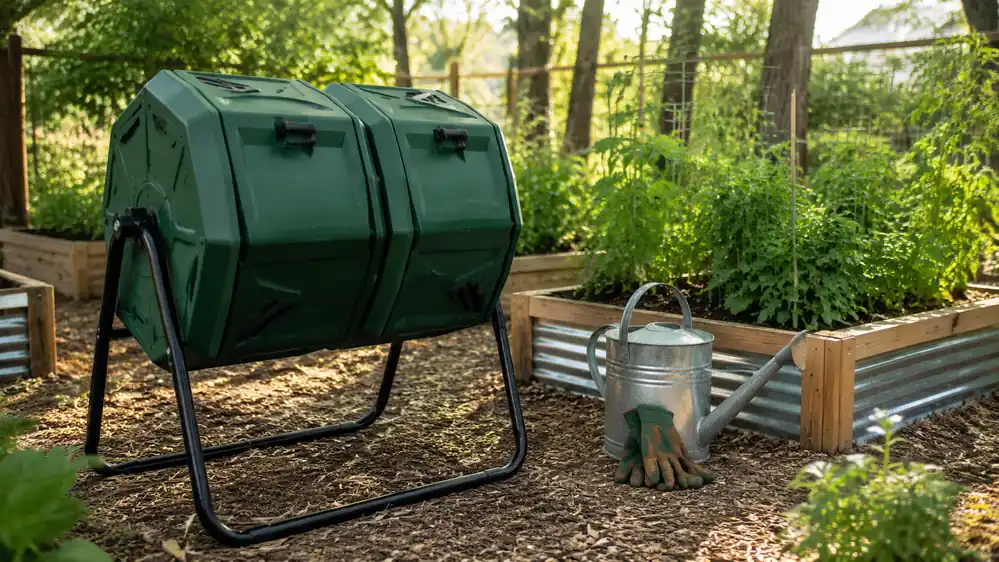
For years my compost setup was an open wire bin in the back corner of the yard, and it worked about as well as most open piles do, which is to say slowly and inconsistently. I'd turn it with a pitchfork every couple of weeks when I remembered, raccoons got into it twice, and in a wet spring it would sour and smell like something had gone wrong even when nothing really had. Last spring I finally replaced it with the F2C dual-chamber tumbler, the 43-gallon black model on the steel A-frame, and I've run it continuously for a full year now.
This isn't a two-week test where I filled it once and called it a review. I've cycled four full batches through it since last April, from grass clippings and coffee grounds in spring to a mountain of fall leaves and kitchen scraps through the holidays. The tumbler sitting in my side yard right now has a faded sticker, one dented door track, and a lot of finished compost to show for the last twelve months, so I want to walk through what actually happened, not what the box promised.
The Quick Verdict
A genuinely useful dual-chamber tumbler that speeds up composting compared to an open pile, with the caveat that it needs a real ratio of greens to browns to work as fast as the marketing implies. Solid steel frame held up all year, one door track needed adjusting in month eight.
Amazon Check Today's Price →Tired of a Compost Pile That Never Finishes?
The F2C tumbler lets you fill one side while the other finishes, so you're never starting from scratch. Check today's price and current availability on Amazon before your next batch of scraps piles up.
Amazon Check Today's Price on Amazon →How I've Used It: A Full Year, Not a Weekend Test
I run a fairly ordinary suburban half-acre with six raised vegetable beds, two apple trees, and a lawn that gets mowed weekly through the growing season. That's a steady supply of grass clippings, fallen fruit, and kitchen scraps, plus a big burst of leaves every October. The dual-chamber design was the main reason I picked this over a single-barrel tumbler. You fill one side, let it cook while you fill the second side, and by the time chamber two is full, chamber one is usually close to finished. In practice that's exactly how I've used it, and it's kept me from ever having a totally empty bin waiting on a batch.
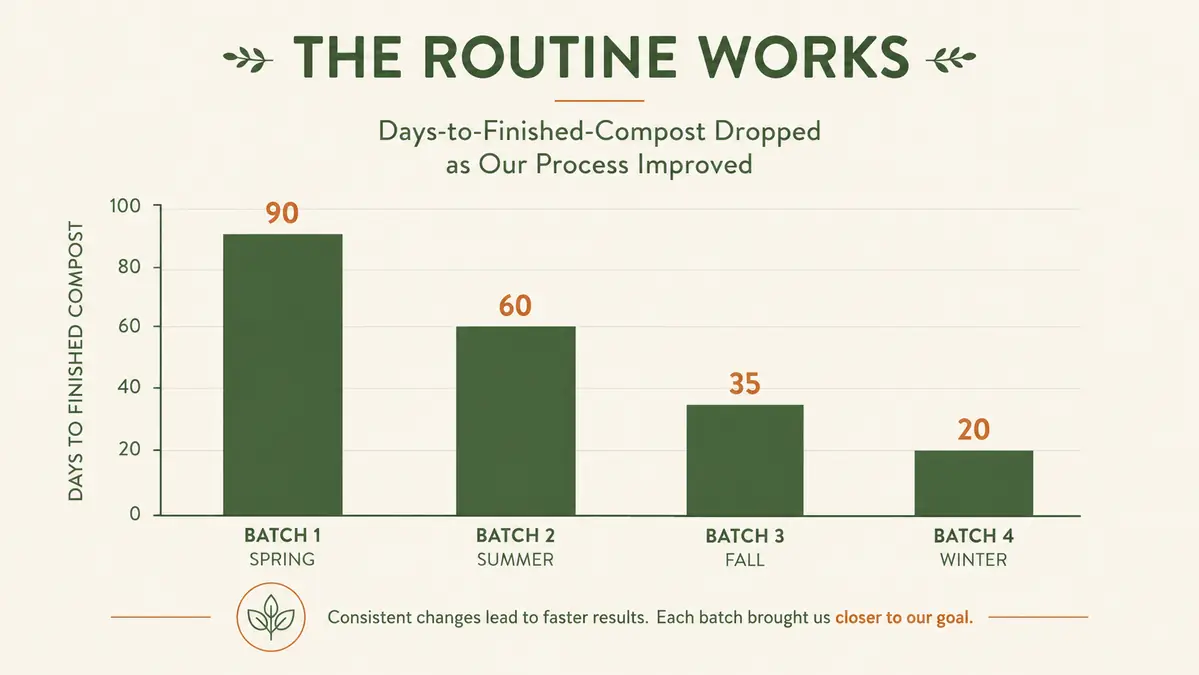
Over the year I ran four distinct batches through each chamber, staggered so I always had something either curing or being added to. My first batch, started in April, was mostly grass clippings and kitchen scraps with shredded newspaper mixed in for carbon. It took closer to ten weeks to get to a usable, crumbly compost, which was slower than I expected going in. By batch three in late summer, once I'd figured out the right balance of green material to dry brown material, I had finished compost in about five weeks. That gap between my first attempt and my third is the single biggest lesson from this whole year: the tumbler speeds things up, but it doesn't fix a bad ratio for you.
The 43-gallon total capacity, split between the two chambers, is enough for my household of four plus yard waste from a half-acre lot, but I wouldn't want less if you're running a bigger garden or a family that cooks a lot at home. I filled both chambers completely during the October leaf drop and had to hold extra leaves in a separate pile until chamber one opened back up, which tells you it's sized right for a typical yard, not oversized with room to spare. If your property backs up to a wooded lot or you're running a bigger vegetable operation than six raised beds, it might be worth looking at a larger capacity model, or accepting that you'll supplement with a second bin during the heaviest weeks of fall.
Turning the Drum: Easier Than a Pitchfork, Still Real Work
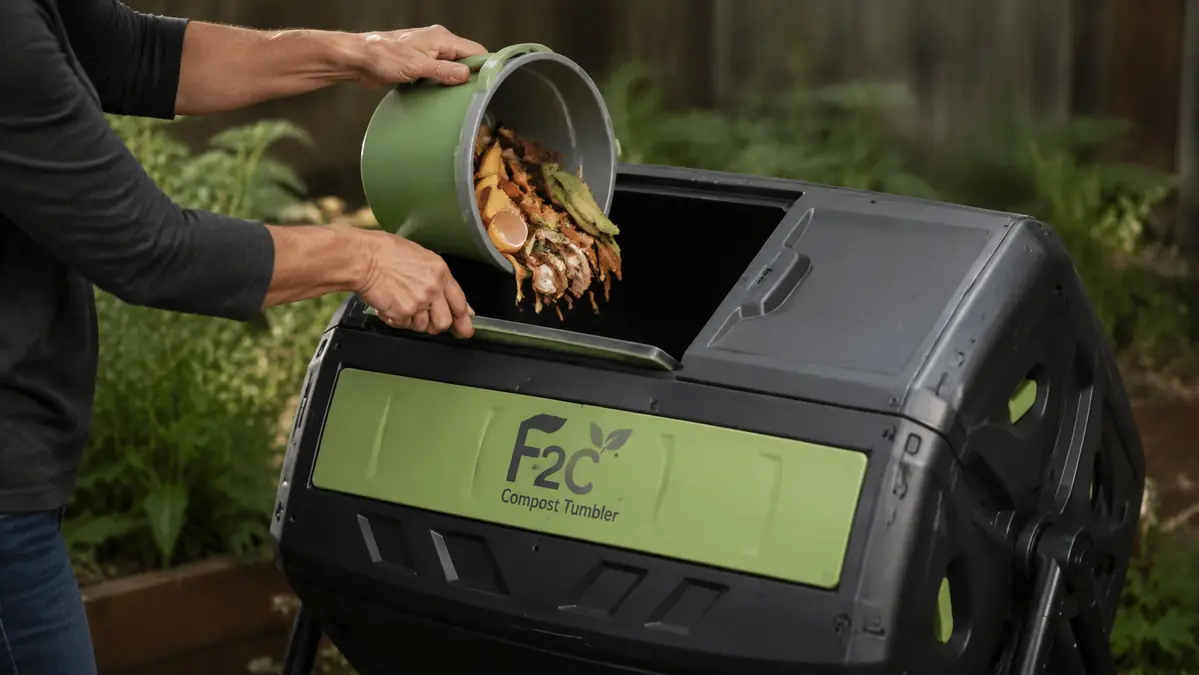
The main selling point of any tumbler over an open pile is that you turn the whole drum on its axis instead of digging into a pile with a fork. On the F2C, the drum sits on a solid steel frame and rotates on two end caps, and I give each chamber a handful of full rotations every two to three days when there's active material inside. It genuinely takes under a minute per side, which is a big improvement over the fifteen minutes I used to spend forking over the old wire bin.
That said, I want to push back a little on how effortless some reviews make it sound. When a chamber is fully loaded with wet material, especially right after adding a big batch of grass clippings, the drum gets heavy and the rotation takes real effort, more like turning a stiff car jack than spinning a beach ball. It's manageable for me at 46 years old with an average build, but if you've got shoulder or wrist issues, don't assume this is a no-effort solution just because it's a tumbler instead of a shovel.
The sliding doors on each chamber are the other detail worth mentioning. They let you add material or scoop out finished compost without tipping the whole drum over, which sounds minor until you've used a top-loading tumbler that requires you to rotate the opening to the top every single time. F2C's sliding door design has held up well, though the track on my second chamber's door started sticking around month eight. A little silicone spray on the rail fixed it, and it hasn't stuck since.
What a Full Year Did to the Steel Frame and the Drum
The tumbler lives outside year-round in my side yard, uncovered, through a summer that hit the mid-90s more than once and a winter with two weeks below freezing. The solid steel frame has held up genuinely well. No rust bleeding through the powder coat, no wobble in the legs, and the bolts holding the frame together are all still snug without me having to retighten anything. For a piece of outdoor equipment that never gets a break from the weather, that's a better result than I expected from a mid-priced compost bin.
The plastic drum itself is BPA-free polypropylene, and it's shown no cracking despite direct summer sun for a full season. There's some fading on the sun-facing side, the black has gone slightly matte and gray compared to the shaded side, but that's cosmetic and hasn't affected how it seals or turns. I did have one air vent cap on chamber one snap off in July, likely from me forcing a rotation while the drum was overloaded rather than from any defect, and I haven't bothered replacing it since the compost still breaks down fine with one less vent.
The biggest thing I learned this year wasn't about the tumbler at all. It was that a fast finish depends more on what you put in than what you're spinning it in.
Speed and Quality: What Actually Came Out the Other End
F2C's own materials suggest finished compost in as little as two to four weeks under ideal conditions, and I want to be straight with you that I never hit the low end of that window. My fastest batch, the third one in late summer, took about five weeks with a deliberate mix of fresh grass clippings, shredded cardboard, and coffee grounds, turned every other day and kept damp but not soaked. My slowest batch, the fourth one over a cold snap in December and January, sat closer to eleven weeks because the material barely heated up once nighttime temperatures dropped into the 30s.
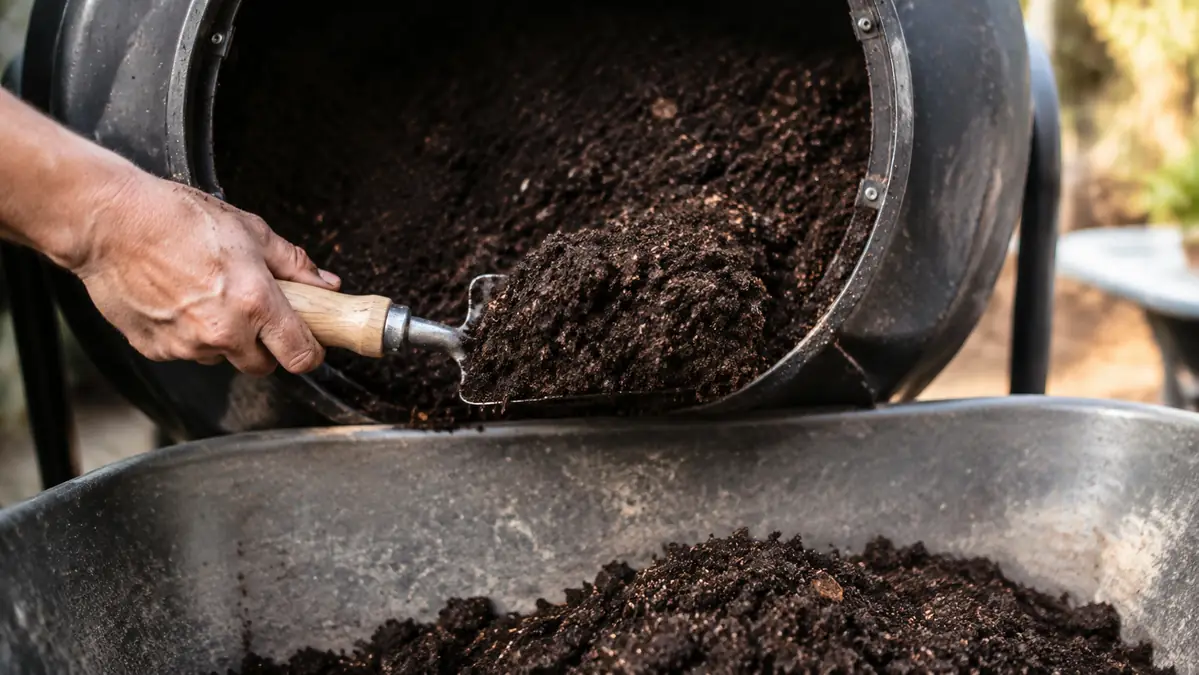
That's not really a knock on the tumbler so much as basic composting physics. Cold slows any composting method down, tumbler or pile, and I should have expected it going in. What the tumbler did give me over the old wire bin was consistency and control. Sealed chambers held moisture better through a dry August than the open pile ever did, and I never had the sour, ammonia-like smell that used to show up in the old setup when things got too wet. What came out at the end of each finished batch was dark, crumbly, and earthy-smelling, exactly what you want to dig into a vegetable bed.
I ran a rough count across the year and estimate I pulled somewhere around 60 gallons of finished compost total from the four batches combined, which covered top-dressing all six raised beds twice plus a healthy amount worked into the soil around both apple trees. For the price, that's a meaningful volume of usable material, and it's compost I know the exact ingredients of, unlike a bagged product from the garden center.
Alternatives I Considered Before Buying
Before settling on this dual-chamber F2C tumbler, I looked at a couple of single-barrel tumblers in a similar price range. They're simpler and usually a bit cheaper, but the tradeoff is real: with one chamber, you either have to stop adding fresh material while a batch finishes, or you keep tossing new scraps in and never get a clean, fully finished batch because you're constantly restarting the clock. The dual-chamber setup solved that problem directly, and after a year of use I'm confident it was the right call for how much waste my household actually generates.
I also seriously considered just building a three-bin wooden system, the kind you see in a lot of homestead videos, where you turn material from one bin to the next as it breaks down. It's cheaper if you're handy with lumber, and it holds more volume, but it also takes up a lot more yard space and it's the open-pile problem all over again when it comes to pests and smell. With two dogs who think anything that smells like food scraps is fair game, a sealed tumbler won that argument pretty quickly. I also didn't love the idea of a wooden structure sitting against the fence line for years, slowly rotting and needing to be rebuilt, when a powder-coated steel frame was going to handle the same job with a lot less long-term maintenance.
A worm bin was the third option I looked at, mostly for kitchen scraps rather than yard waste. It's a great system if you're working with limited outdoor space, but it can't handle the volume of grass clippings and fall leaves my yard produces, and I didn't want to manage two separate composting systems when one tumbler could handle both.
What I Liked
- Dual chambers meant I always had one batch curing while the other filled, no dead time waiting for an empty bin
- Solid steel frame showed no rust or wobble after a full year outside in sun, rain, and freezing temperatures
- Sliding doors made adding scraps and scooping finished compost simple, no tipping the whole drum
- Sealed design kept smell and pests away completely, a real upgrade over my old open wire bin
- Turning each chamber takes under a minute when it's not fully loaded
Where It Falls Short
- Finished compost took five to eleven weeks depending on season and mix, not the two to four weeks suggested on the box
- A fully loaded chamber gets genuinely heavy to rotate, not effortless the way some marketing implies
- One door track started sticking around month eight and needed silicone spray to fix
- An air vent cap snapped off when I forced a rotation on an overloaded chamber
- Total capacity fills up fast during a big leaf drop if you're working a larger yard
Who This Is For
If you've got a yard that generates a steady stream of kitchen scraps, grass clippings, and fallen leaves, and you're tired of an open pile that smells, attracts wildlife, or never seems to finish, this tumbler is a solid step up. The dual-chamber setup especially makes sense if you want to keep adding fresh material without constantly restarting a single batch, and if you're willing to actually manage the ratio of green to brown material rather than tossing everything in and hoping for the best.
Who Should Skip It
If you're expecting finished compost in two weeks flat regardless of season or what you feed it, you'll be disappointed, because real composting still depends on temperature and material balance no matter what you're turning it in. And if you've got a very small kitchen-scraps-only setup with no outdoor yard waste, a countertop bin or a worm bin will probably serve you better and take up a lot less space than a 43-gallon steel-framed tumbler in the yard.
Ready to Stop Fighting an Open Compost Pile?
The F2C dual-chamber tumbler is available today on Amazon. Check current pricing and availability before your next batch of scraps starts piling up on the counter.
Amazon Check Today's Price on Amazon →